Thanks to my daughter Kathy for naming this blog.


Bald Eagle in Anchorage, Alaska

Translate

Wednesday, October 5, 2016

Crime Rate in the United States

The rate of violent crime in the United States in 2015 is the lowest in forty-five years, except for the preceding year, 2014.  Nevertheless, Republican candidates and conservative media are portraying the country as beset by violent crime.  The rise and fall of violent crime over the past 55 years deserves more serious treatment. 

Donald Trump made Law and Order one of the main themes of his acceptance speech at the Republican National Convention.  Trump painted a picture of America torn by violent crime, as seen in a few excerpts from his speech below.  Conservative news channels, such as FOX News, One America Network, and talk radio have also made crime a major issue in the campaign, in an attempt to discredit the Obama administration and the Democratic Party.

Donald Trump, Acceptance Speech at the Republican National Convention, 2016:
“I have a message for all of you: the crime and violence that today afflicts our nation will soon come to an end. “
“Decades of progress made in bringing down crime are now being reversed by this Administration’s rollback of criminal enforcement.”
“Homicides last year increased by 17% in America’s fifty largest cities. That’s the largest increase in 25 years. In our nation’s capital, killings have risen by 50 percent. They are up nearly 60% in nearby Baltimore.”
“I will restore law and order our country.…I am the Law And Order candidate. “

But let’s look at the data.  The FBI has gathered statistics on crime since 1960.  The FBI data shows that recorded levels of violent crime increased dramatically from 1960 to 1991, rising nearly five-fold.   Obviously, it is unknown how much of the increase is due to improved tracking and record-keeping.  Violent crime peaked at 758 incidents per 100,000 people in 1991.  Since 1991, all classes of violent crime have decreased dramatically.  The murder rate has fallen by 56%; rape has declined 36%; robbery is down 64%; and aggravated assault is down by 49%.   The murder rate in 2015 is lower than any year since 1960, except for the preceding year, 2014.  


United States Violent Crime, 1991 – 2025
The rate of all classes of violent crime has declined by 54% since 1991. 
 
The rate of murder has declined by 56%.  
It might be noted that most of the decline in murder rates occurred under Democratic presidents.


The rate of forcible rape has declined less than other types of violent crime; by only 36%.
The rate of robbery is down 64%, and the rate of aggravated assault is down 49%.

United States Violent Crime, 1960 – 2015

The FBI began compiling a national database on violent crime in 1960.   The complete record shows the rise and fall of crime over the past 65 years.

The murder rate in 2015 is lower than any other year since 1960, except for 2014.  It is likely that medical advances have helped to reduce the incidence of violent death.  The same improvements in trauma care that have saved lives on the battlefield have probably saved lives in hospital emergency rooms over the past two decades.
Of all violent crimes, the rate of forcible rape shows the greatest increase since 1960, and the smallest decline since 1991.  Efforts over the past decades to improve reporting may be reflected in the higher rate.  Nevertheless, the poor results in reducing rape is a national disgrace.  Reducing rape will require broader education and prevention efforts than those needed to control other crimes.
The rate of aggravated assault has declined by 49% since 1991.   Except for the year 2014, the rate in 2015 is lower than in any year since 1974.
The robbery rate in the United States has declined by 64 percent since 1991.  The robbery rate in 2015 was lower than in any year since 1966.

Causes and Conclusions
The decline in America crime since the early 1990s is truly remarkable.  It is even more remarkable, considering that during this period crime reporting probably improved through the use of information technology.  The decline in crime through the past 25 years is as striking and difficult to explain as was the increase in crime which occurred in the preceding 25 years.  


Violent crime in the United States of all kinds experienced a protracted rise from 1960 through 1991.  The summary statistics are dominated by aggravated assault and robbery, but all kinds of violent crime increased about four or five fold during that period.   In 1991, the rate of violent crime began a long, steady fall, declining about 50% over the next 25 years.  Violent crime reached a minimum in 2014, followed by a slight up-tick in 2015.

Theories for the Rise and Fall of Violent Crime
Various theories have been proposed to explain the long decline.  Age is known to be a major factor in the perpetrators of violent crime, with crime peaking at about age 18.   It has been suggested that demographic shifts in the population are responsible for the decline in crime, but the decline of 18-year-olds in the population is less than the decline in crime.

A strong case can be made for environmental exposure to lead in childhood as a cause of the rise and fall of crime rates.  Data going back to the late 1870s shows a correlation between lead exposure and crime, with a lag time of slightly more than 20 years.

And the National Rifle Association, naturally, attributes the decline in crime to higher rates of gun ownership in the United States.  This conclusion is challenged by others taking a more detailed look at the data.

Economists Steven Dubner and Steven Levitt, authors of Freekonomics, proposed another theory, noting that the nationwide decline in crime followed the legalization of abortion by twenty years.  They further noted that states that legalized abortion a few years before the Roe v. Wade decision showed an earlier decline in crime rates.  Like other issues in the abortion debate, these results were challenged; nevertheless, Dubner and Levitt maintain that data support their conclusion.

A final and important issue is the incarceration rate in the United States.  The incarceration rate rose sharply in the 1980s and 1990s, rising about five-fold from 1972 to 2008.   The high incarceration rate was the result of stricter sentencing guidlines nationwide, and a no-tolerance program relating to the war on drug use.  Although the United States has only 4.4 percent of the world's population, this country holds 22 percent of the world's prison population.  There is a strong racial disparity in imprisonment; black men are imprisoned at a rate about six times higher than the rate for white men.   It is notable that crimes of forcible rape have decline far less than other kinds of violent crime. Whatever factor is causing the decline in violent crime is only partly effective in preventing forcible rape.

The high incarceration rate appears to broadly correlate to the decline in crime rate seen in the past twenty-five years.  And the reversal of incarceration rates which began in 2008 may play a part in the rise in crime rates now occuring in many cities in 2016.   Further work is needed to see if cities with greater relaxation in incarceration rates experienced a greater reversal in the trend crime rates.

There is still much to learn about the causes of violent crime, and the policies necessary to keep crime low.  But the fundamental point of this blog post is that violent crime in the United States is now at the lowest point in forty years.  The Republican view that the United States is now beset by violent crime as a consequence of the Obama presidency is simply a lie.  Donald Trump's address in which he claims to be the "law and order candidate" would have been appropriate in 1992, but like many other aspects of his candidacy, is simply obsolete, a throwback not appropriate to today's society.
------------
References

Donald Trump Acceptance Speech

United States Population

FBI Crime Statistics
Data from 1960.

Academic paper, Crime trends in Europe over centuries

Wikimedia charts have references and citation info.

Incarceration Rate
detailed data from 1980, chart to 1920.

Historical Corrections Statistics in the United States, 1850-1984

Freekonomics correlation between abortion and crime

Age and Crime
Duplicate material with the following.  Unclear which source is original.
Encyclopedia of Crime and Justice
COPYRIGHT 2002 The Gale Group Inc.

Lead exposure and Crime
Remarkable and strong correlation between childhood lead exposure and crime, following a lag of 23 years. 

Gun ownership and Crime Rate.  Note that the charts do not specify households owning guns, but rather only the number of privately owned guns. 


Is America a Highly Taxed Country?

Conservatives often say that America is one of the highest-taxed nations in the world.  My father recently told me this.  Donald Trump also said the same thing in the same words in his acceptance speech at the Republican National Convention. 

If this were true, it would be a problem worthy of examination and serious discussion.  The problem is that it isn’t true.  It isn’t remotely true.  America is one of the lowest-taxed nations in the world.  If it were true that America is a highly-taxed country, it should have a reasonable influence on American tax and spending policies.  We might infer that the United States government is inefficient, compared to other countries.  We might want to focus on cost-cutting, instead of raising revenue to close our fiscal deficit.  But it isn’t true.

Let’s look at the data.

OECD Federal Tax Burden
The Organization for Economic Cooperation and Development is a group of thirty-four countries, which includes all of the Western industrialized economies.  The organization gathers comparative economic data from all member countries.  Tax rates represent tax revenue from all sources, including businesses and individuals.  Taxes include individual income taxes, business income taxes, and all other taxes, including sales taxes, value-added taxes, excise taxes, import/export taxes, natural resource royalties and production taxes.  Tax rates are measured in terms as a percentage of GDP, which is the standard measure of the tax burden across several sources.  The data is available here: http://stats.oecd.org/Index.aspx?DataSetCode=REV

The United States Federal tax rate is second-LOWEST of the OECD, at 10.5% in 2013 (the latest year with complete reporting).  Only Switzerland, at 9.5%, has a lower Federal tax rate.  The United States’ Federal tax rate would have to approximately double to reach the average tax rate for the rest of the OECD. 
The US tax rate has been consistently among the lowest of the OECD for years.  The following chart shows federal taxes for all OECD countries from 2008 to 2013.

OECD Total Tax Burden
The OECD also maintains records for the total tax burden for member countries.  Total taxes include Social Security (or equivalent) taxes, State and Regional taxes, and Local taxes, also measured as a percentage of GDP.   The United States total tax burden is fourth-lowest of the 34 OECD countries, behind South Korea, Chile and Mexico.
The United States total tax burden is 25% of GDP; the OECD average (ex-US) is 34%.  The United States total tax burden would have to increase 35% to reach the average total tax burden of the rest of the OECD.
The US total tax rate has also been consistently low for years.  The following chart shows total tax burden from 2008 – 2013. 
World Federal Tax Rate
The World Bank is an alternative source of tax data, including data from most nations on earth.   Only Federal or central authority tax data are available.  For the year 2011 (the recent year with the most complete reporting), the United States had the fourteenth-lowest Federal tax rate in the world.
The data is available for download on this site:  http://data.worldbank.org/indicator/GC.TAX.TOTL.GD.ZS

The list of countries with lower taxes than the United States is as follows:
Ethiopia, Pakistan, India, Afghanistan, Bangladesh, Central African Republic, West Bank and Gaza, Lithuania, Oman, Nigeria, Bahrain, Estonia, United Arab Emirates.

From 2009 through 2011, the United States had the lowest tax rate in the OECD, so no OECD countries appear in this list.

The time series data is a fairly messy chart, because of the number of countries included in the plot, but it is clear that the United States has consistently had among the lowest Federal tax rates in the world.

Federal Government Expenses
Taxation is one thing.  Government spending is another thing.  Data on Federal Government expenses are available from the World Bank.  As of 2011, the United States is eighth lowest of the 34 OECD countries in terms of Federal spending as a percentage of GDP.
If we assume that all countries federal governments are performing equally relative to the size of their economies, then those with the highest expenses (Portugal, Austria, Hungary, New Zealand, Greece) would be the least efficient.  The countries with the lowest expenses (Switzerland, Canada, South Korea, Japan, Spain, Chile, United States) would be considered the most efficient.

But I think it can be argued that the United States’ federal government is doing more than many other governments in terms of infrastructure, scientific research, environmental protection, etc.  Further, as of 2013 the United States is spending more than the next nine countries combined, accounting for 40% of the world’s military spending.  Military spending consumes over 50% of the nation’s $1.1 trillion-dollar discretionary budget.  Considering the burden of military spending, it is apparent that the United States Federal Government performs the remaining functions of government very efficiently.

Conclusions
The main point is that Donald Trump said that the United States is among the most highly-taxed countries in the world.  And that is absolutely not true.  We among the lowest-taxed countries in the world.  That is what the data say. 

It matters, because in the course of informing the public and influencing policy, false information will lead to the wrong conclusions.

If the United States were actually highly-taxed compared to the rest of the world, we might think that the United States government is inefficient.  But knowing that we are among the lowest-taxed countries, if all governments are doing equally well, we have to conclude that our government is efficient.  If we are doing better than other countries, and paying less tax (adjusted for our deficit spending) we have to conclude that our government is very efficient.

I like living here.  I like safe drinking water, safe food, safe medicines, safe working conditions and good roads.  I like having the leading science research and leading universities of the world.  I like having a justice system that protects me from discrimination and arbitrary prosecution.  I like having a reasonably strong military, although I don’t think military spending should consume half of the discretionary federal budget.  I like having financial regulations and consumer product regulations that rein in the worst players in our business world, such as Wells Fargo and Turing Pharmaceuticals.  I like having a pension program that protects seniors and provides for their medical care, although again, I question those costs, which are being borne by young people whose wages are lower than their parents’ wages.  I like having toilet paper in government buildings (except our national parks), which is something missing in some other countries I that I have visited.  I like that our cars are now five times safer than in 1965, thanks to government regulations. I like that air travel is 1700 times safer than 1965, thanks to government regulations.  I like that the in Los Angeles is 98% cleaner than in 1965, thanks to government regulations.  All of these things cost money.  I am willing to pay to continue living in the leading country; I think we should all be willing to pay more to maintain those services and standards. 

If we had conditions like those in other countries with tax rates comparable to ours, I would think we lived in a pretty shitty country.

We have been systematically under-taxed since the 1980s.  It was an interesting experiment, to see if economic growth would allow us to keep low tax rates, or if cutting down on funding would make government more efficient.  Perhaps there was a measure of success.  But we have now accumulated a large debt, and it is time to start paying our bills.  Because every dollar of deficit spending is a dollar stolen from our children and grandchildren, who will not have the opportunity to keep rolling over the debt.  Interest payments on the debt are now 14% of our federal spending, at a time when interest rates are virtually zero.  When interest rates rise, those debt payments will become crushing, unless we simply print money to pay it off.  We can do that for a while, but I don’t think it will end well.

So, it is wrong to say that we are among the highly taxed countries in the world.   We are not.  It matters because it leads to bad policy.  And we ought to be paying higher taxes to maintain our position as a leading country, and to avoid stealing from our children.

The tax revenue/GDP parameter is a way to measure fairness.  If an American is paying 10% of gross income in individual income tax (excluding Social Security and Medicare payroll taxes), including all unrealized and deferred capital gains (401k, IRA), then they are pulling their weight.  Unfortunately, due to the complexity of the tax code, it is difficult to tell who is paying their fair share of taxes, and there is a widespread belief that the system is unfair. 

I think we should reform our tax system to make it simpler, more transparent, and give all taxpayers confidence that they system is fair.
-------------------
Another version of this post is published on the blog "Wonky Thoughts", DougRobbins.Blogspot.com.  

Sunday, August 14, 2016

Unemployment Rate

A major theme of the current presidential election is whether the country is doing well under the current Democratic administration.  Republican candidate Donald Trump is making the case that conditions are terrible, and require a change.  One of Trump’s claims is that the official unemployment rate is “a hoax”.  Trump claims that actual unemployment rate is as high as 42%.
Let’s look at some of the data.

The unemployment rate since 1980 has fluctuated with the business cycle.  Recessions cause sharp increases in unemployment, followed by years of recovery.  The business cycle is about 7 to 10 years long. 

Non-farm employment since the 2009 recession has grown at a steady pace.   The chart shows a similar slope to the increasing numbers of jobs during the years of the 2nd Bush administration.
The Bureau of Labor Statistics also collects data on “discouraged” workers, who are no longer looking for work.  This adjustment adds about a half-percent to the base unemployment rate, but does not significantly change the pattern of improvement over the past seven years.

There is a persistent conspiracy belief among conservatives that the unemployment numbers published by the BLS are altered by the administration to appear better.   This has been rebutted by several economists and economic publications.

Economist Jeff Frankel writes: "The truth is that presidents don’t and can’t manipulate the jobs numbers. No White House has even tried — at least not since Richard Nixon made a heavy-handed attempt in 1971 to interfere with BLS staffing. After that, extra firewalls were put in place."

For those who do not believe government statistics, we can compare the independent evaluation of unemployment done by Gallup, by household surveys.   The Gallup survey corresponds closely to the BLS unemployment rate without seasonal adjustment.
Some problems do exist in the economy, and there are reasons for underperformance compared to previous decades. 

First, and most significantly, there are large numbers of part-time workers who want full-time work.  In the aftermath of the 2009 recession, record numbers of workers accepted part-time work instead of full-time work.  Those numbers have remained stubbornly high through the economic recovery.  If these workers are included with unemployed workers, the unemployed/underemployed rate remains at a stubbornly high 10 percent after declining from 17 percent during the height of the Great Recession.
The reason that many people cannot find full-time employment is really obvious, to anyone familiar with employment practices at a "big-box" retail store, and federal employment regulations.  According to current Federal law, employers do not have to provide full benefits to part-time employees.  In particular, employers do not have to offer health insurance to part-time employees.   This single fact explains the historically high number of workers working part-time, but desiring full-time work.  This fact also explains why the Affordable Care Act was necessary, in order to make health insurance available to millions of workers and their families without health insurance.

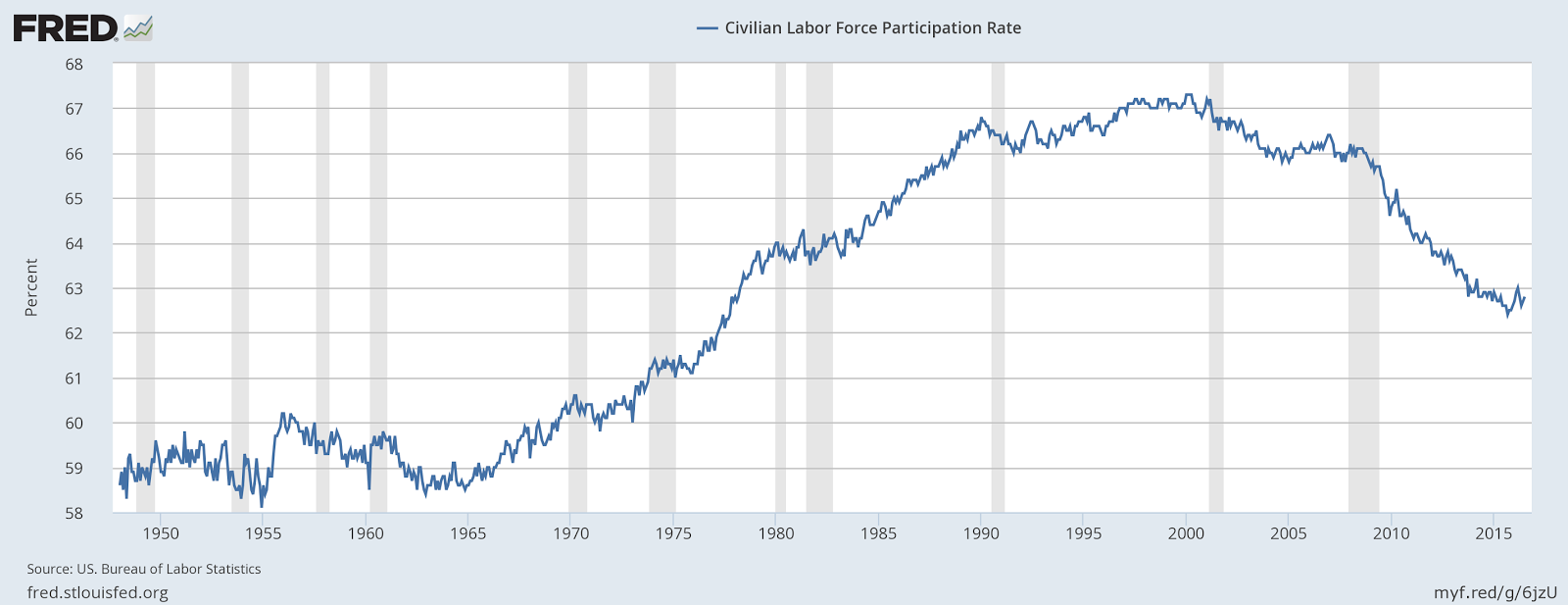
Secondly, another issue is declining participation in the labor force.   Labor force participation among adult Americans peaked in the late 1990s at 67%, and has declined to about 63% in 2016, representing an increase of about 17 million people not working.  
A major factor in this change is the aging of the baby boom population.  Comparing statistics from 2014 and 2004, there are 7 million more retirees in 2014, and 4 million more people who are ill or disabled.  There are about 5 million more people going to college, and 1 million more out of the workforce for other reasons.  The decline of labor force is not primarily due to discouraged workers, but rather is the due to the aging of the baby boomer generation.

In the most recent months, labor force participation has ticked upward slightly, and discouraged workers return to the labor force.   Still, the labor force is likely to remain a smaller percentage of the population than in 2000, due to the demographic aging of the population and longer lifespans.

The record of the Obama administration has been a continuous improvement in the unemployment rate and number of jobs since the recovery from the 2009 recession.  In truth, I believe that the business cycle is the dominant factor in determining the level of employment in the economy, and that the presidential administration deserves little credit or blame for the unemployment rate.  But for those who would label the policies of the administration a failure, based on the nation's unemployment rate, they should look at charts and understand the numbers.

---
References

Trump claims that government (BLS) unemployment rate is incorrect.   Trump claims a 58% unemployment rate for African American youth.  
Non-working population includes retirees, youth, stay-at-home parents (25% of adult population).  I would also include care-givers for seniors.
Actual unemployment rate is correct, at under 5%.   Labor force participation is down from 65% to 62.8%.
Video of Trump speech.
Reasons for decline in labor force participation.
7 million more retirees, 4 million more ill or disabled,  5 million more going to school in 2014 than in 2004.

Friday, July 22, 2016

Republican Blame Game

This is a bit of a rant.   I've listened to some speeches from the Republican National Convention, and bits from Fox News, Brietbart News, Rush Limbaugh, Charles Krauthammer, and other right wing commentators.  Republicans are consistently doing things to screw things up, and then blaming the Democrats for the results.  Here is a list.

Republicans cut Federal taxes far below Federal spending, and blame Democrats for Federal debt.

Republicans increase military spending to 5x times more than next most militarized country, continue to blame Democrats for Federal debt.

Republicans block meaningful gun control, blame Democrats for gun violence.

Republicans block affirmative action and other race equalization measures, blame Democrats for increased race animosity.

Republicans block increases in minimum wage, blame Democrats for decline of working-class families.

Republicans block abortion, blame Democrats for welfare mothers.

Republicans cut school funding in school districts nationwide, blame Democrats for decline in student performance.

Republicans cut funding for consulate security, blame Democrats for attack on Benghazi embassy.

Chris Christie breaks New Jersey law in bridge closure, says that Hillary Clinton should go to prison.

Republicans spread lies about President for eight years, blame Democrats for lying.

Republican Congress creates gridlock in Washington, blame President for failures of Federal government.

Republicans start wars which cost trillions, continue to blame Democrats for Federal debt.


Donald Trump solicits foreign government officials for campaign contributions, Republicans blame Hillary Clinton for accepting foreign contributions to the Clinton Foundation.

Republicans claim Christian values, deny shelter to Syrian war refugees.


Wednesday, July 20, 2016

Letter to Mike Pence, Regarding the Indiana "Religious Freedom Law"

Our civilization and culture were built by people of men and women of all races, skin color, religious convictions, national origin and sexual orientation.   We owe a debt of gratitude to the gays and bisexuals who wrote our poetry, our plays, and our music; made discoveries in mathematics, science and economics, and protected our freedom.  We should honor that debt by extending courtesy, dignity and equality in all things to people of every sexual orientation.

------
Mike Pence is a conservative Republican governor of the State of Indiana, a former U.S. Representative and radio talk-show host.   Governor Pence has just been selected as the Vice-Presidential running mate of Donald Trump, Republican nominee for President of the United States.

In 2015, under Governor Pence, the Indiana State Legislature passed a law allowing individuals and business to deny services to people on the basis of sexual orientation.  The rationale for this legalized bigotry was the pretext of religious freedom.  The law is one of many proposed by Republicans in dozens of states to legalize discrimination against people on the basis of sexual orientation.  Under the law, businesses which disapprove of homosexuality for religious reasons could deny services, housing, or employment to gays.  Governor Pence signed the legislation.  It is clear that the law was a response to the legalization of gay marriage.  The law was intended to impede the implementation of the national gay-marriage law, through harassment and denial of services to gays.  

A firestorm of national criticism ensued.  Several prominent Indiana companies protested the legislation.  A number of national interests declared various boycotts on Indiana.  Within two weeks, an amendment protecting the rights of gays was added to the legislation, effectively nullifying the law. 

Here is a letter that I wrote to Governor Pence following his signing of the Indiana Religious Freedom Restoration Act.

“Dear Governor Pence

I am an Indiana native, and a master's degree graduate of Indiana University.  I am deeply ashamed of my home state, ashamed of your actions, and ashamed of the State Legislature.

In keeping with the spirit of your "religious freedom" law, you could ban all performances of the works of William Shakespeare; all art by Michelangelo and Leonardo Da Vinci; all music by Tchaikovsky, Wagner, Leonard Bernstein, Elton John and Freddy Mercury; the plays of Oscar Wilde, Thornton Wilder and Tennessee Williams; poems of Walt Whitman and essays by Ralph Waldo Emerson; economics of John Maynard Keynes, and any commemoration of victory in World War II, which might have been lost without the  genius of Alan Turing, who deciphered Nazi codes during the war.

Regretfully, Turing and Tchaikovsky were hounded to the point of suicide by the actions of people like you.

Or, as a suggestion, you might honor our debt to these great people, and many others like them, by extending courtesy and equality to all people regardless of sexual orientation.”


Saturday, June 18, 2016

Primary Election Reform

America is in a situation of political division which is unprecedented in my lifetime.  Our government processes are paralyzed by partisanship.  The tone of political rhetoric in the media and in public life has reached levels of ugliness that I never before experienced.  Politicians in office increasingly represent the extremes of our political spectrum rather than the middle.  The presidential candidates chosen by both political parties are viewed unfavorably by a majority of the public.

We need to reform the process by which we winnow the field of potential candidates to nominees who participate in the general election.  Our political parties administer these process, with party rules that are wildly inconsistent and unfair.  It is time for the government to take control of these processes, and to make changes in the interest of better government and a healthier society.

 A simple change to our election processes would address many of these problems.  If we replace our system of closed party primary elections and caucuses with an open general primary, it would force candidates to seek support from the middle of the political spectrum, rather than the extremes.  I believe this would set the country on the course of solving our problems.  

Primary Election Reform
Donald Trump and Hillary Clinton are poised to compete for the Presidency of the United States as candidates of America’s major political parties.  The candidates will set a record as the most detested presidential candidates for as long as public opinion has been recorded.  It is an indication of the increasing polarization of American society, and an indication that our political system is broken.
How did we come to be in this situation in a democracy, where people choose the very candidates that they dislike?  The problem is in our system of winnowing the field of candidates through primary elections and party caucuses.

Our system of primary elections is partly to blame for our political dysfunction and gridlock.  The system divides the electorate into partisan camps.  Each camp tends to select a candidate who epitomizes the most partisan views of that camp.   The process produces a government which lurches from extreme to extreme at the highest levels, and a government which is locked in acrimonious and dysfunctional gridlock at lower levels.  We have created a government in which the willingness to compromise is seen as a fatal flaw.  The judicial system, which is the strongest stabilizing force in American government, has likewise become a battleground of ideology.   Political discourse has become increasing bitter over the past 25 years, and political conflicts increasingly violent. 
The major political parties, Democratic and Republican, are essentially private clubs, who presently dominate the processes of winnowing candidates for all political offices.  The parties dictate the processes of winnowing the pool of candidates in a mind-numbing morass of differing primary election and caucuses, with different rules in every state. (The process is detailed at the end of this article for readers unfamiliar with the American system).   The process rewards corruption, and allows established political powers and wealthy political donors to strongly influence the selection of the party candidates.  It is in the interest of the nation to remove that power from the parties, and institute primary elections which are fair and equal for all citizens.

Primary election processes must be reformed.  A reformed process of winnowing the field of candidates would necessarily force candidates to compete for the middle of the political spectrum.  Politically extreme candidates would be eliminated from contention in general elections.   Reforming our primaries would improve the policies that govern the nation and allow the smooth functioning of government.

Reform Proposal – Simultaneous Open Primaries and Negative Votes
Winnowing the slate of candidates for office is far too important to be left to the whims of political parties.  There is ample justification in the Constitution to overturn our current system, and establish a new system, which will provide of equal rights to all citizens in the selection of our political candidates. 

The solution to our problem is remarkably simple.  We must establish general primary elections, to be held simultaneously in all states.  Candidates would compete for votes from all citizens, decreasing our tendency to elect extremists from the ends of the political spectrum.   Candidates would be less bound by party orthodoxy, and able to express a range of opinions, which would be healthy for our general political discourse.  The top two candidates in the general primary would compete in the general election, eliminating the problem of a three-way race, in which two candidates with similar views split a majority vote, allowing a candidate supported by a minority to win an election.  The process should be applied at every level, from President to mayor of the smallest hamlet.

I would propose a further variant.  The power to say “NO” is an important element of decision-making, embodied in the President’s veto power over actions of Congress, and in Congress’ power, with a super-majority, to override the President’s decisions.   That power should also be given to the voters.  I would suggest, that in any primary election with more than three candidates, each citizen should be given three votes: two positive votes, and one negative vote.   In a field of many candidates, such as we had in this Presidential cycle, the “NO” votes would eliminate extreme and unpopular candidates.  I think a system which gives citizens a veto would produce a government more accurately of the people, by the people, and for the people. 

When candidates compete in an open primary, by necessity, they must learn to represent all of the people.  Success will depend on winning over the middle of the political spectrum, rather than the extremes.   Candidates will be empowered to express views on some issues which are outside of their party orthodoxy, and they will be empowered to compromise with their political opposition
We are at a political crossroads in America.  We are on the edge of collapse of the two-party system which has generally governed our country since its inception, and in the current form which has existed for over a century.   We have the opportunity now to make it better, and we may never have another chance.

 ------------------------------------------------------------------------------------------------------------------------
The following section is added for readers unfamiliar with the American system of Primary Elections.

The American System of Primary Elections and Caucuses
In general, America has a two-party political system.  I the American system, candidates for political office compete for nomination by the political party of their affiliation.  The candidate chosen for nomination then compete in a general election against the candidate of the other major party.  Occasionally, there are candidates from minor political parties, or independent candidates, but these are rarely significant in the general election.  

Each party sets its own rules for winnowing the field of candidates to determine a nominee, for both national and local offices.  In fact, the parties set different rules in each state, resulting in a patchwork of irregular processes depending upon location.  

In most states, the nominee is selected by the result of a primary election.  In some states, the primary is restricted to only party members; in some states the primary is open to independent voters; in some states open to all voters.  Some states employ another variant.  Instead of an election, the nominee is selected through local meetings termed caucuses.  The caucuses require several hours of time.  Caucuses are attended by only about 5 percent of the population.  By comparison, about 35 to 40 percent of the population participate in primary elections. 

Primary elections are held according to an arbitrary schedule, at various times in various states.  The process gives the states with early voting a disproportionate influence on results, by directing additional media attention and political donations to the winners of the early contests.  Those early results tend to reflect the parochial interests of those states, rather than the broader interests of the nation. 

The Republican Party (ironically) has a more ‘democratic’ system than the Democratic Party.  Republicans have given more power directly to the voters in the system of primary elections.  Essentially all of the Republican delegates are chosen by primary election results, and those delegates are bound to vote according to primary election results on the first ballot at the party convention.  The Democratic Party allocates about one-eighth of the delegates to existing party officials and office-holders. 

The parties also have processes which give considerable power to established political interests.  Both parties have “rules committees” which are able to change the rules for nomination, even after the conclusion of all primary voting. 

In the current presidential election cycle, Donald Trump prevailed over the established powers of the Republican party, riding a wave of populist rage and racist rhetoric to overwhelm the establishment candidates.  In the Democratic Party, the establishment candidate Hilary Clinton called upon a deep well of political obligations owed to her husband, Bill Clinton, from his eight-year presidency.  Even so, she narrowly prevailed against a more articulate and extreme candidate from the left side of the political spectrum, Bernie Sanders.   Neither partisan racist mob-rule, nor entrenched political dynasties serve our country well.  

Monday, January 13, 2014

Governor Christie and the Politics of Intimidation

In an act of political reprisal, the staff of New Jersey Governor Chris Christie created a traffic jam last September which delayed a half-million people for 3 to 4 hours each day over a period of four days.  The target of the reprisal was one small-town mayor who refused to endorse Governor Christie for re-election.

The term "abuse of power" has been missing in news reports about the incident.  But abuse of power is exactly the crux of the scandal in New Jersey.  Governor Christie and his staff were put in office to use that power for the betterment of all citizens, not to use that power for their own political gain.

The scandal illustrates the politics of intimidation as practiced by Governor Christie, and is a preview of what we can expect if he is successful in his campaign to be the next President of the United States.
----------
Ghengis Khan understood.  Niccolo Machiavelli understood.  And Chris Christie, governor of the the State of New Jersey, also understands.

What they understand is that intimidation is an effective means of seizing and keeping power.     

Niccolo Machiavelli wrote that intimidation was necessary for a prince to gain and keep power.  Machiavelli wrote that it is good if a leader is loved, but better if he is feared and respected.  To be only feared is insufficient, and to be only respected is insufficient.  To be feared and respected would ensure that potential opponents would find it better to be supporters of the prince.

It is sad, but likely, that every prominent politician plays this game.  It is human nature to reward supporters, and to punish opponents, to regard supporters as friends, and opponents as enemies.  And intimidation – the selective application of punishment – is an effective way to turn opponents into supporters. 

In many other countries, the political process of punishment and intimidation is harsher than in the United States.  In Kiev, former Prime Minister Yulia Tymoshenko is serving a seven year prison term for corruption, in what is generally regarded as political retribution.  In Russia, dissident Mikhail Khodorkovsky was recently released from a ten year sentence.  Although convicted of tax evasion, Khodorkovsky was clearly imprisoned for political opposition to Vladimir Putin.  And in North Korea, the new ruler Kim Jong Un put his uncle to death, either by being blown to bits by anti-aircraft guns, or torn apart by a pack of starving dogs, depending on what report is to be believed.   The more severe the punishment, the more effectively it stifles opposition.
----
 For four days last September, Governor Christie’s staff and appointees caused a traffic jam as an act of political retribution.  A traffic jam seems like a fairly minor issue, except that the traffic jam was staged on the busiest bridge in the world.  The George Washington Bridge connecting New Jersey to New York City carries nearly 300,000 cars every day, including buses and other vehicles with multiple passengers.  The traffic jam caused 3 or 4 hours of delays for more than 500,000 people.   According to information in the news, this is a conservative estimate.

Consider for a moment the scope of the traffic jam, and let’s compare it to Mikhail Khodorkovsky’s sentence of ten years for political opposition to Vladimir Putin.  Khodorkovsky paid the price of 87,600 man-hours for opposing Putin – ten years of a man’s life.   On the George Washington Bridge, a half-million people (who were completely innocent of the dispute) lost at least three hours each for four days, for about 6 million man-hours.   The time wasted is equivalent to 684 years of human life.  Which of these reprisals is more egregious?

 The closure of lanes on the George Washington Bridge was an act of punishment for one man, the mayor of a small town of 35,000 people.  The mayor, a member of the opposition party, refused to endorse Governor Christie’s campaign for re-election.  Governor Christie's staffers apparently hoped that the mayor would lose his own election due to public anger about the traffic.   

Governor Christie built his public image as a moderate politician, able to work across party lines with President Obama, and able to secure the endorsements of Democratic Party mayors and officials within the state.  The foundation of those endorsements is now deeply in question.  How many endorsements has he won through respect, and how many endorsements has he won through intimidation?

Governor Christie, so far, has avoided being directly implicated in the scandal.  Nevertheless, if at least four of his senior staff and appointees are involved, how can he be innocent of the general strategy of political intimidation? 

Governor Christie is currently the leading candidate from the Republican Party for the office of President.  If this event is indicative of the way he and his staff operate, what would these people do with the full power of the NSA to identify political opponents throughout the country?

As Machiavelli observed, to maintain power, it is necessary to be regarded with fear and respect.  Chris Christie may still be regarded with fear, at least within his home state of New Jersey.  But for me, it is difficult to imagine how Chris Christie can still be regarded with respect on the national stage.